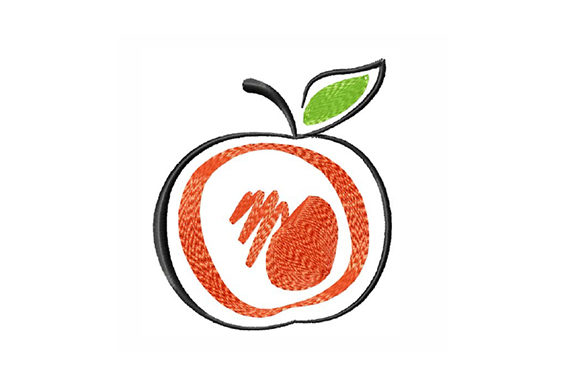
Hand Drawn Apple
A Friendly, Handmade Symbol That Builds Brand Warmth
As an embroidery designer who’s developed hundreds of designs for small businesses—from neighborhood bakeries to indie florists—I immediately recognize the quiet strength in Hand Drawn Apple. It doesn’t shout. It invites. The title alone signals authenticity: “hand drawn” implies approachability, care, and human touch—qualities that resonate deeply with handmade brands, Etsy sellers, and local shops building trust through visual storytelling. Paired with its description—“a symbol of fertility,” “quality embroidery for kitchen clothes, interiors, curtains, towels”—this isn’t just a food-themed motif. It’s a versatile brand anchor rooted in nourishment, growth, and domestic warmth.
Real-World Performance Across Small Business Merchandise
In practice, Hand Drawn Apple shines where personality meets practicality. On staff aprons for a café or boutique, it reads as thoughtful—not generic. As a chest patch on uniforms, its stylized silhouette holds clarity without overwhelming; it complements name tags and logo placements rather than competing. For cap embroidery, it works best on structured front panels (not curved bill seams), especially when scaled to 2.5–3 inches wide—large enough to preserve line integrity but compact enough for professional proportion.
On tote bags and reusable market sacks, Hand Drawn Apple becomes a subtle signature—ideal for craft studios or farm-to-table brands wanting soft branding over loud slogans. As a sleeve detail on chef coats or artisan work shirts, it adds charm without compromising function. And for product packaging accents—think embroidered twill tags on linen tea bags or organic soap wraps—it elevates perceived value by reinforcing a handmade product ethos.
For Etsy sellers and creative studios, this machine embroidery design translates beautifully into printable mockups. Its clean outlines and balanced negative space allow crisp rendering across digital previews, helping buyers visualize how their custom apparel or boutique merchandise will look *before* stitching begins.
Where to Use Hand Drawn Apple With Intention
Not every surface is equal—and Hand Drawn Apple rewards thoughtful placement. Avoid scaling it below 1.75 inches for embroidered patches: fine interior lines may collapse, especially on textured fabric like terry cloth towels or heavy canvas totes. Cap fronts demand extra attention—test stitch-outs on real caps first, as curvature can distort hand-drawn curves and reduce legibility.
Dark uniforms? Prioritize high-contrast thread colors. A rich forest green apple on charcoal grey linen reads cleanly—but pale yellow or cream thread may vanish. Likewise, dense stitch density (if present in the embroidery file) needs verification: overly tight fills can stiffen lightweight fabrics used in kitchen linens or children’s apparel. Always inspect spacing between stem and fruit outline—tight gaps risk merging during production, especially on low-stabilizer runs.
How Hand Drawn Apple Strengthens Brand Identity
For small business merch, consistency is credibility—and Hand Drawn Apple delivers visual continuity across touchpoints. Used alongside a simple wordmark or monogram, it forms part of a cohesive design system: warm but not childish, rustic but not dated, food-adjacent but broadly resonant. Customers associate it with care—whether on a bakery’s flour-dusted apron or a pet brand’s organic cotton bandana (yes, apples read surprisingly well beyond Food category when styled thoughtfully).
This isn’t just decoration. It’s a recognition cue. Repeat exposure builds familiarity. When a customer sees Hand Drawn Apple on a staff member’s cap, then again on their receipt sleeve and tote bag, it silently reinforces professionalism and intentionality—key drivers of buyer engagement and loyalty.
Practical Embroidery Designer Notes Before Production
Before committing to bulk runs, follow these field-tested steps:
- Test in black and white first. This reveals contrast issues invisible in color previews—especially critical for dark garments and multi-thread layering.
- Check small-patch viability. Resize the embroidery file to your target patch dimensions (e.g., 2” x 1.5”) and simulate stitch simulation—look for thin stems or delicate leaf details that may vanish.
- Review thread color contrast against your base fabric. Order physical thread swatches if possible—digital screens lie.
- Confirm hoop size compatibility. If using multi-position hoops or automated frames, ensure the design fits within standard 4x4 or 5x7 boundaries—or verify if larger formats are needed.
- Test on real fabric with correct stabilizer. A towel’s loop pile behaves very differently than smooth poplin. Use tear-away for stable weaves; cut-away for stretch or knit fabrics.
- Create a client-approved mockup. Show stitched samples beside other design assets—logo, typography, packaging—to assess visual harmony.
- Verify commercial licensing. Since this is intended for small business merch and branded patch use, confirm the digital embroidery file includes rights for resale, promotional use, and commercial embroidery projects.
Final Thought: More Than a Fruit—A Brand Gesture
Hand Drawn Apple succeeds because it balances simplicity with soul. It doesn’t try to be everything—it’s a focused, intentional mark. For embroidery shops stitching for local businesses, it’s a reliable, conversation-starting asset. For Etsy sellers launching custom apparel, it’s a ready-made element of authenticity. And for any small business seeking to signal warmth, quality, and grounded values? It’s a quiet, confident yes.